
Cold Storage Panel Systems for Malaysia’s Growing Sector

Cold Storage Panel Systems: Solving Malaysia’s Rapid Expansion Problem
Malaysia’s cold chain logistics sector is growing at 8–12% annually. Food importers, pharmaceutical distributors, and aquaculture processors are racing to expand capacity — and they need space fast. The problem is that traditional cold room construction takes 4–6 months, ties up significant capital, and routinely exceeds budget by 20–30% before a single pallet moves through the door.
Facility managers increasingly choose modular solutions that go live within weeks. That shift is why the cold storage panel has become the default build method across Malaysian industrial zones — from Shah Alam to Johor Bahru.
Cold Storage Panel vs. Traditional Construction: The Real Numbers
Installation Time
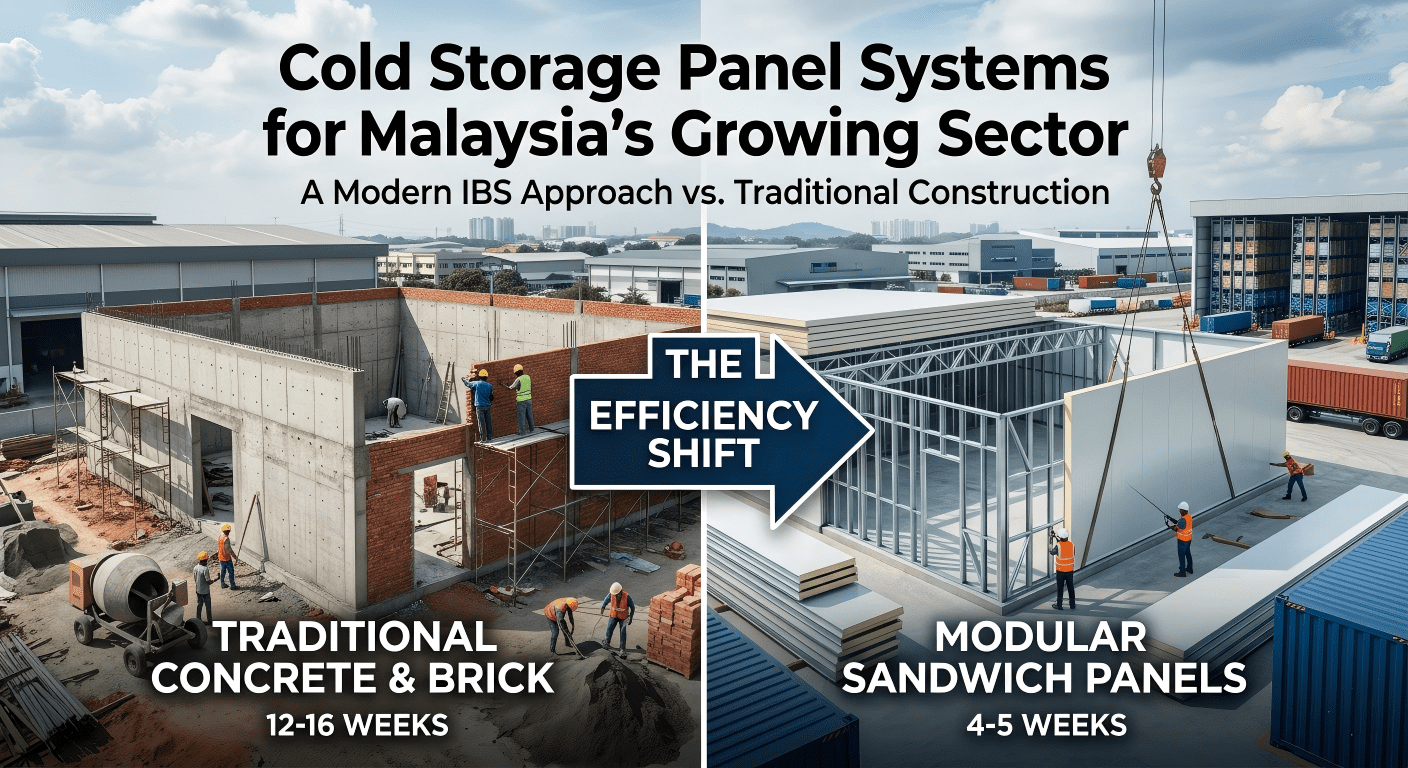
Traditional brick, concrete, and spray-foam construction follows a slow sequence: site preparation (2–3 weeks), structural framing (3–4 weeks), insulation (2–3 weeks), finishing and sealing (2–3 weeks). That’s 12–16 weeks minimum — and that assumes no weather delays or subcontractor scheduling gaps.
A modular cold storage panel system compresses the same scope to 4–5 weeks: foundation prep takes 3–5 days, panel assembly runs 1–2 weeks, electrical and mechanical rough-in takes one week, and commissioning wraps up in 3–5 days. A 500 m² cold room in Selangor can be operational in 30 days instead of 120.
Capital and Operating Costs
Traditional construction runs RM 800–1,200/m² with contingency overruns of 15–25% being common. Annual maintenance sits at 2–3% of installation cost, and thermal efficiency typically drops 10–15% within five years as materials settle, crack, and absorb moisture.
Cold storage panel installation costs RM 600–900/m² with predictable pricing and minimal overruns. Annual maintenance drops to 0.5–1% (mostly gasket and seal checks), and thermal performance holds above 95% over ten years. For a 1,000 m² facility, that’s a realistic saving of RM 150,000–400,000 on day one — before you account for lower ongoing energy and maintenance bills.
Thermal Performance in Malaysia’s Climate
Spray foam at 100mm delivers an initial R-value of 5.5–6.0, but Malaysia’s humidity is unforgiving. Moisture absorption degrades performance by 0.5–1% annually, and thermal bridging at structural columns can account for 15–25% of total heat loss at connection points. Within 3–5 years, real-world performance is measurably worse than the spec sheet.
A 100–150mm polyurethane-core cold storage panel starts at R-value 6.0–7.0 and degrades less than 0.1% per year. Factory-sealed cores don’t absorb moisture. Continuous panel design eliminates the bridging problem at columns. The result is a system that performs closer to its design rating for its entire service life.
Maintenance and Longevity
Traditional cold rooms need annual inspections, periodic foam repairs, and structural work every 5–7 years — typically RM 50,000–150,000 per intervention. Concrete cracking from thermal cycling is common after year three in tropical conditions.
Cold storage panels require quarterly gasket and seal checks. Gasket replacement for a large facility runs RM 5,000–15,000 annually. Individual panels can be swapped out without shutting down the rest of the facility. Expected service life is 20–25 years with no structural repairs under normal operating conditions.
Where Mechanically-Produced Panels Outperform Hand-Assembled Alternatives
Not all cold storage panels are equal. Hand-assembled panels vary by ±5–10mm in dimension. That might sound minor, but over a 50-panel run, cumulative gaps create thermal bridges, complicate installation, and add 2–3 days of on-site shimming and adjustment.
Mechanically-produced panels hold tolerances to ±2mm across an effective width of 1,120mm. Joints close cleanly. Thermal bridging is minimised. Installation moves faster because the panels actually fit as specified.
The wider 1,120mm effective width also means fewer panels per linear metre compared to 960mm alternatives. A 2,000 m² facility needs roughly 1,800 mechanically-produced panels versus 2,100 hand-assembled ones — fewer joints, fewer potential failure points, and 15–20% less installation time.
U-values for quality mechanically-produced panels sit at 0.18–0.22 W/m²K depending on core thickness. Independent field testing in Kuala Lumpur conditions — 29°C ambient, 85% humidity — showed actual performance within 1.2% of design specifications after 18 months. Spray foam installations in the same region deviated 8–12% from spec over the same period.
Case Study: Pharmaceutical Cold Storage Expansion in Klang
A pharmaceutical importer needed to grow cold storage capacity from 800 m² to 1,500 m² in 90 days to fulfil new distribution contracts. Traditional construction would have missed that window by 4–6 weeks, costing the business the contracts entirely.
The solution was 700 m² of modular cold storage panels rated for 2–8°C pharmaceutical storage. Installation finished in 28 days. Temperature variance held within ±0.5°C. Energy consumption came in 18% lower than the existing spray-foam facility built eight years earlier. Capital saved versus traditional construction: RM 180,000. The facility went live 60 days ahead of the contract deadline.
Mechanical production tolerances eliminated on-site shimming and cut electrical rough-in time by three days — a detail that sounds small until you’re managing a 90-day commissioning window.
BOMBA Compliance: Fire Safety Requirements for Cold Storage in Malaysia
Cold storage facilities in Malaysia must comply with fire safety standards enforced by BOMBA (Jabatan Bomba dan Penyelamat Malaysia). This is a non-negotiable requirement for facility approval — and the choice of panel core material directly affects whether a facility passes inspection.
Standard polyurethane (PU) foam, while thermally efficient, has a lower fire resistance rating. Under sustained heat exposure, PU panels can contribute to smoke generation, which conflicts with BOMBA’s requirements for smoke control and evacuation in enclosed storage environments.
Polyisocyanurate (PIR) panels are the preferred choice for Malaysian facilities subject to BOMBA review, for three reasons:
- Higher fire resistance: PIR foam achieves a Class 1 surface spread of flame rating under BS 476 Part 7, outperforming standard PU in fire scenarios. The rigid char layer formed during combustion slows flame spread and reduces smoke output.
- Lower smoke toxicity: PIR’s char-forming combustion produces less toxic smoke than PU, which is a key factor in BOMBA’s evaluation of enclosed cold rooms where evacuation time matters.
- Thermal stability under fire conditions: PIR maintains structural integrity longer than PU at elevated temperatures, giving occupants and emergency responders more time to respond before panel failure.
For pharmaceutical storage, food-grade cold rooms in commercial zones, and any facility requiring a BOMBA fire certificate (Sijil Perakuan Bomba), specifying PIR panels from the outset avoids costly remediation after the inspection stage. Upgrading from PU to PIR typically adds 15–25% to panel cost — a fraction of the cost of a failed inspection, rework, and delayed commissioning.
When sourcing panels for a BOMBA-regulated facility, request the fire test certification for the specific panel product — not just the core material in isolation. Facing material, joint design, and overall panel assembly all factor into the fire rating. A reputable supplier will provide full test documentation aligned with MS 1514 (Malaysian Standard for fire protection) or equivalent international standards accepted by BOMBA.
The Right Cold Storage Panel for Your Facility
The case for cold storage panel systems over traditional construction is straightforward in Malaysia’s operating environment. The 4–5 week installation window, 20–30% cost advantage, superior thermal stability in high-humidity conditions, and low maintenance overhead make them the practical default for food, pharmaceutical, and logistics operators expanding capacity today.
Mechanical production standards deliver the consistency that hand-assembled panels cannot. For any facility where deployment speed and long-term performance both matter, a quality cold storage panel system returns measurable ROI within the first 18–24 months of operation.
If you’re scoping a new cold room or expanding an existing facility in Malaysia, talk to a supplier who can back up panel specifications with field performance data — not just catalogue numbers.
Frequently Asked Questions
Can cold storage panels be installed in an existing building?
Yes. Existing concrete or steel-frame structures can be lined with cold storage panel systems without major structural modification. A 500 m² retrofit typically takes 2–3 weeks, provided the existing structure is sound. Floor and ceiling adjustments are usually minimal.
How long do cold storage panels last in Malaysia’s climate?
Expect 20–25 years under normal operating conditions. Gasket seals need replacement every 5–7 years at a cost of roughly RM 3,000–8,000 depending on facility size. If a panel is damaged, it can be replaced individually without dismantling the surrounding system.
How do cold storage panels handle Malaysia’s humidity?
Factory-sealed polyurethane cores resist moisture absorption far better than site-applied spray foam. Field data shows less than 0.1% annual thermal degradation for quality panels, versus 0.5–1% for traditional foam. Tight mechanical tolerances — ±2mm at joints — also reduce the gap points where moisture typically enters over time.
Do cold storage panels meet BOMBA fire safety requirements in Malaysia?
It depends on the panel core material. Standard PU panels may not meet BOMBA’s smoke control and fire resistance requirements for enclosed cold storage. PIR (polyisocyanurate) panels are the recommended choice — they achieve higher fire resistance ratings, produce less toxic smoke, and maintain structural integrity longer under fire conditions. For any facility requiring a BOMBA fire certificate, specify PIR panels and request full fire test documentation from your supplier before procurement.