
PU Edge-Sealed Rock Wool Panels Philippines | Fire Rated A1

Introduction: GB/T 23932-2009 and Asset Protection
In the Philippines’ rapidly expanding industrial and commercial construction sector, the selection of proper building materials represents both a significant investment decision and a critical safety consideration. GB/T 23932-2009, the Chinese national standard governing fire-resistant sandwich panels, has emerged as a benchmark for asset protection across Southeast Asia, including the Philippines.
This standard specifically addresses the fire performance requirements for sandwich panels used in building envelope systems, with particular emphasis on core materials and their edge sealing technologies. For Philippine facilities facing the dual threats of fire hazards and extreme weather conditions, understanding these specifications becomes essential to long-term asset protection.
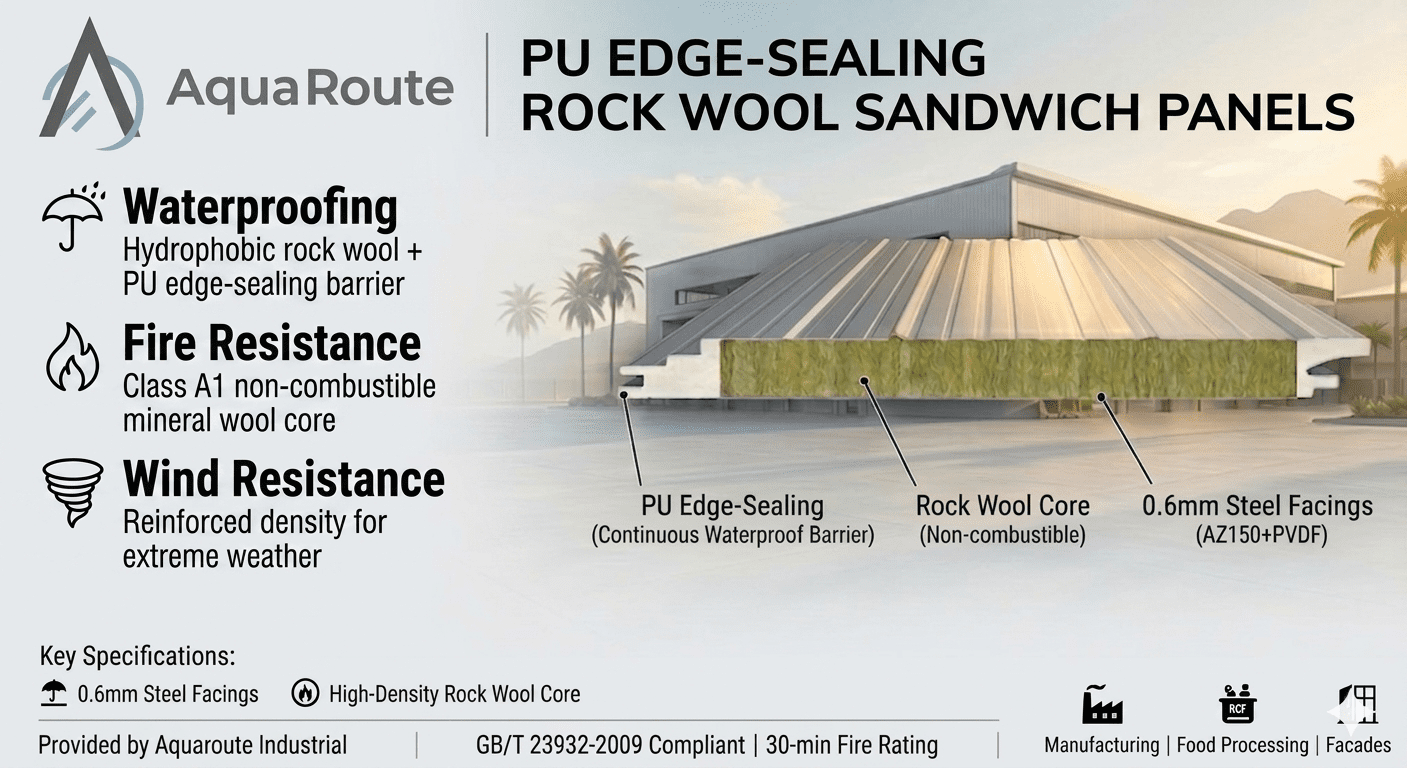
PU edge-sealed rock wool sandwich panels represent the convergence of fire safety engineering and moisture resistance technology. Unlike conventional sandwich panel systems, these hybrid solutions utilize the inherent fire-resistant properties of mineral wool while addressing its traditional weakness—moisture absorption—through polyurethane edge sealing.
For procurement professionals and engineers in the Philippines, selecting appropriate sandwich panel systems requires navigating a complex landscape of material specifications, local environmental factors, and cost considerations. This guide aims to provide a comprehensive framework for evaluation, selection, and implementation of PU edge-sealed rock wool sandwich panels in the Philippine context.
The Specification Matrix: Comparing Core Materials
When evaluating sandwich panel options for Philippine projects, three primary core materials dominate the market: PU edge-sealed rock wool, standard polyurethane (PU), and expanded polystyrene (EPS). Each presents distinct performance characteristics across critical parameters.
| Performance Parameter | PU Edge-Sealed Rock Wool | Standard PU | EPS |
|---|---|---|---|
| Fire Rating | 30min-120min fire rated (Class A1 non-combustible core) Meets GB/T 23932-2009 |
15-30min with fire-retardant additives Combustible core |
10-15min Highly combustible |
| Moisture Resistance | Excellent (PU sealed edges prevent capillary action) Water absorption <1.5% |
Very good Water absorption <2% |
Poor Water absorption 3-5% |
| Typhoon Resistance | High (180-220 kg/m³ density) Wind load resistance up to 250 km/h |
Medium (38-42 kg/m³ density) Wind load resistance up to 200 km/h |
Low (16-20 kg/m³ density) Wind load resistance up to 150 km/h |
| Thermal Insulation | Good K-value: 0.043-0.045 W/m·K |
Excellent K-value: 0.022-0.028 W/m·K |
Good K-value: 0.036-0.040 W/m·K |
| Sound Insulation | Excellent (30-35 dB) | Fair (20-25 dB) | Poor (15-20 dB) |
| Metal Facing Options | PVDF, AZ150 Galvalume, Stainless Steel | PVDF, AZ150 Galvalume, Stainless Steel | PVDF, AZ150 Galvalume, Stainless Steel |
| Warranty Period | 10-15 years | 5-10 years | 3-5 years |
The matrix clearly demonstrates why PU edge-sealed rock wool panels command premium positioning in the Philippines market. For facilities requiring 30min fire rated solutions—particularly manufacturing plants, food processing facilities, and data centers—the additional investment delivers measurable safety benefits while addressing the traditional moisture vulnerabilities of conventional rock wool panels.
Cost & ROI Analysis
Understanding Price per Square Meter in the Philippines
The cost structure for sandwich panels in the Philippines varies significantly based on core material, thickness, facing material, and import duties. Current market rates (as of 2023) for PU edge-sealed rock wool panels range from ₱1,400 – ₱1,800 per square meter, with other panel types priced proportionally.
These base prices typically include standard metal facings but exclude installation costs, which average ₱350-500 per square meter depending on project complexity and location within the Philippines.
For accurate budgeting, procurement professionals should consider several influencing factors:
1. Steel Thickness: The gauge of metal facings significantly impacts panel strength and price
2. Core Density: Higher density rock wool cores provide better acoustic and structural performance
3. Coating Type: Different coating systems offer varying degrees of weather and corrosion resistance
4. Order Volume: Bulk orders typically qualify for volume-based pricing advantages
PVDF Longevity vs. Initial Investment
PVDF (polyvinylidene fluoride) coatings represent the premium option for metal facings in the Philippine context due to their superior resistance to UV radiation and salt-spray environments. With a service life exceeding 20 years, PVDF-coated panels with AZ150 Galvalume substrate provide optimal protection in coastal environments like Manila, Cebu, and Davao.
The ROI calculation becomes particularly favorable when comparing:
- Initial Cost Premium: PVDF coating adds a premium compared to standard polyester coatings
- Maintenance & Cleaning Expenses: Standard polyester systems require more frequent maintenance
- Downtime Costs: Facility operations interruption during maintenance represents additional indirect costs
For a typical 2,000 square meter industrial facility in the Philippines, the 15-year cost comparison reveals significant total ownership cost advantages for premium systems with proper edge sealing and PVDF coatings.
Maintenance Savings with PU Edge-Sealed Systems
The PU edge-sealing technology directly addresses the primary maintenance vulnerability of traditional rock wool panels—moisture infiltration through panel edges. In the Philippine climate, with its high humidity and frequent heavy rainfall, this protection delivers quantifiable maintenance savings:
1. Mold Remediation Avoidance: Typical remediation costs for mold in traditional rock wool systems can be substantial
2. Thermal Efficiency Preservation: Wet insulation loses 40-60% of its thermal efficiency, increasing cooling costs in air-conditioned spaces
3. Structure Longevity: Moisture migration into steel supporting structures accelerates corrosion, potentially reducing building lifespan by 10-15 years
The financial analysis indicates that while PU edge-sealed rock wool panels carry a premium over standard panels, facilities with critical operations or high-value contents typically recover this investment through reduced maintenance costs and risk mitigation.
The Capillary Threat: Understanding Moisture Dynamics
The primary engineering challenge with traditional rock wool sandwich panels lies in their fiber structure’s inherent capillary action. This phenomenon, where moisture is drawn into microscopic spaces between mineral fibers through surface tension, represents a significant vulnerability in the humid Philippine climate.
PU Edge-Sealing Chemistry
The polyurethane edge-sealing technology employs a high-pressure injection system that creates a chemical bond between PU resin and rock wool fibers. This process involves:
1. High-Pressure Injection: The PU resin is injected under pressure to penetrate and bond with the rock wool fibers
2. Chemical Bonding: The PU resin forms molecular bonds with the rock wool fibers, creating an effective moisture barrier
3. Complete Edge Encapsulation: The process ensures that all edges are fully sealed against moisture intrusion
This advanced sealing method creates a closed-cell polyurethane barrier with the following properties:
- Water Vapor Transmission Rate: <0.5 perms
- Closed Cell Content: >90%
- Adhesion Strength to Rock Wool: >150 kPa
- Service Temperature Range: -40°C to +80°C
The chemical bonding between the PU edge seal and the metal facings creates a continuous moisture barrier that prevents the ingress of water through panel joints and edges.
Rock Wool Moisture Absorption Mechanics
Standard rock wool insulation typically demonstrates the following moisture behavior:
- Short-Term Water Absorption: 1-1.5 kg/m² after 24-hour immersion
- Long-Term Water Absorption: 3-3.5 kg/m² after 28-day partial immersion
- Capillary Rise Potential: Up to 200-300mm vertically when exposed to standing water
This absorption capacity becomes particularly problematic in the Philippines, where:
1. Annual Rainfall: Manila averages 2,061mm annually, with typhoon season bringing intense precipitation events
2. Relative Humidity: Average RH ranges from 71% (March) to 85% (September)
3. Condensation Risk: High temperature differentials between air-conditioned interiors and hot exteriors create persistent condensation potential
Comparative Performance Testing
Laboratory testing under simulated Philippine conditions demonstrates the effectiveness of PU edge-sealing technology:
| Test Parameter | Standard Rock Wool Panel | PU Edge-Sealed Rock Wool Panel |
|---|---|---|
| Water Absorption After 7-Day Humidity Cycling (75-95% RH) | 2.8% weight increase | 0.3% weight increase |
| Thermal Conductivity Increase After Moisture Exposure | 35-45% increase | 3-5% increase |
| Mold Growth After 30-Day High-Humidity Exposure | Moderate to severe | None to minimal |
The integration of PU edge-sealing technology effectively transforms rock wool from a potentially problematic material in high-humidity environments to a reliable building envelope solution for the Philippine climate.
Professional Installation Guide
Proper installation of PU edge-sealed rock wool sandwich panels is critical to realizing their performance benefits in Philippine applications. The following technical specifications and procedures ensure optimal system integrity.
Structural Support Requirements
Proper structural support is essential for panel performance during typhoon conditions common in the Philippines. The panel system must be installed on an appropriately designed structural framework that meets local building codes and can withstand the environmental loads specific to the Philippines.
Dacromet 410 Screw Installation Protocol
The fastening system is critical to both weather sealing and structural integrity. Dacromet 410 screws provide superior corrosion resistance in Philippine conditions:
- Screw Specifications:
- Dacromet 410 coating (minimum 8μm thickness)
- Self-drilling with EPDM washer
- 5.5mm diameter for standard applications
- 6.3mm diameter for high-wind zones
- Screw Pattern and Density:
- Roof panels: Every valley at end supports, alternate valleys at intermediate supports
- Wall panels: Maximum 300mm centers at panel edges, 600mm centers at intermediate supports
- Additional fixings within 1.2m of building corners
- Torque Requirements:
- Optimal torque: 4-6 Nm
- EPDM washer compression: 30-50%
- Avoid over-tightening that deforms metal facing
- Use calibrated torque drivers for consistent application
Sealing Panel Joints
Proper joint sealing is essential for system performance in the Philippine climate:
- Side Lap Treatment:
- Apply 6mm bead of neutral-cure silicone sealant or butyl tape to female joint before engagement
- Ensure complete compression of sealant when panels are joined
- Wipe excess sealant for clean appearance
- End Lap Treatment (roof applications):
- Minimum 200mm overlap
- Double runs of 6mm butyl tape at overlap
- Stitch screws at maximum 300mm centers
- Flashing Integration:
- Minimum 150mm vertical leg on all flashings
- Apply double runs of butyl tape or closed-cell foam fillers
- Secure flashings with stitching screws at 300mm centers
Local Case Logic: Philippine Environmental Factors
The Philippines presents unique environmental challenges that directly impact sandwich panel performance and longevity. Understanding these factors is essential for proper material selection and system design.
Manila/Cebu High-Salt Environments
Coastal areas of the Philippines, particularly around Manila Bay, Cebu, and other major ports, present aggressive corrosion environments due to salt-laden air and industrial pollution:
- Corrosion Rates: Carbon steel exposure tests in Manila show corrosion rates 3-5 times higher than inland locations
- Salt Deposition: Average chloride deposition rates of 300-500 mg/m²/day in coastal industrial zones
- Material Implications: Standard galvanized facings (Z275) typically show red rust within 2-3 years in these environments
For facilities within 5km of coastlines, specification adjustments are necessary:
1. Facing Material Upgrade: AZ150 Galvalume provides 2-3 times the corrosion resistance of standard galvanizing
2. Coating System: PVDF with minimum 25μm thickness provides superior chemical and UV resistance
3. Fastener Specification: Stainless steel or Dacromet 410 screws with minimum 8μm coating thickness
4. Edge Treatment: Additional edge sealing with neutral-cure silicone at cut panel edges
Typhoon Zone Considerations
The Philippines experiences an average of 20 typhoons annually, with 5-7 making landfall. This creates specific requirements for panel systems:
- Wind Uplift Resistance: Panels must withstand negative pressures of 2.5-3.5 kPa in typhoon-prone regions
- Water Penetration Resistance: Driving rain at 150+ km/h creates water penetration risks at panel joints
- Impact Resistance: Flying debris during typhoons can impact and damage panel surfaces
Engineering solutions for typhoon zones include:
1. Increased Fastener Density: 25-30% more fasteners than standard specifications
2. Enhanced Joint Sealing: Double sealant runs at critical joints
3. Thicker Metal Facings: Minimum 0.5mm external facings (0.7mm preferred in extreme zones)
4. Reinforced Flashings: Heavier gauge flashings with additional fastening points
High Humidity and Mold Risk
The Philippines’ tropical climate creates persistent high humidity conditions:
- Average Relative Humidity: 75-85% year-round
- Condensation Risk: High temperature differentials between air-conditioned interiors and hot exteriors
- Mold Growth Potential: Ideal conditions for mold and mildew development
These conditions make PU edge-sealed rock wool panels particularly advantageous:
1. Moisture Barrier Integrity: The continuous PU edge seal prevents moisture migration into the rock wool core
2. Mold Resistance: The inorganic rock wool substrate provides poor nutrition for mold growth
3. Thermal Stability: Maintained insulation value even with exterior humidity fluctuations
Case Study: Industrial Facility in Zhanjiang, China
A notable installation of 5,200 square meters of PU edge-sealed rock wool panels at an industrial facility in Zhanjiang, China demonstrates the system’s effectiveness in extreme coastal conditions:
- Environmental Challenges: Extreme coastal salinity, frequent typhoons, high humidity year-round
- Panel Specification: 100mm PU edge-sealed rock wool with PVDF coating
- Performance Results: After 8 years of exposure, the panels maintain structural integrity and insulation values with minimal maintenance requirements
This case provides valuable reference for Philippine applications, as Zhanjiang’s coastal conditions closely mirror those found in many Philippine industrial zones.
FAQ: Technical Questions on Rock Wool Sandwich Panels
Question: How do PU edge-sealed rock wool panels maintain fire ratings despite the polyurethane component?
Answer: The polyurethane edge seal represents less than 5% of the total panel volume and is encapsulated between non-combustible components (rock wool core and metal facings). Fire testing to GB/T 23932-2009 confirms that the PU edge seal does not significantly affect the overall fire performance, with panels maintaining their A1 non-combustible core classification.
Question: What is the typical ROI timeframe for upgrading from standard PU panels to PU edge-sealed rock wool in the Philippines?
Answer: For facilities with critical operations or high-value contents, the ROI typically materializes within 4-6 years through reduced insurance premiums, maintenance costs, and risk mitigation. This calculation factors in the higher initial investment against the long-term operational benefits and reduced risk profile.
Question: How do PU edge-sealed rock wool panels perform in terms of thermal bridging compared to standard PU panels?
Answer: PU edge-sealed rock wool panels exhibit slightly higher thermal bridging at panel joints compared to continuous PU core panels. However, the difference is minimal in practical applications, typically resulting in less than 5% difference in overall thermal performance when properly installed.
Question: What is the environmental impact of PU edge-sealed rock wool panels compared to other options?
Answer: These panels offer several environmental advantages: the rock wool core is manufactured from abundant natural resources (basalt rock), contains up to 40% recycled content, and is fully recyclable at end-of-life. The limited PU content (used only at edges) minimizes the overall petrochemical footprint compared to full PU panels.
Question: How do these panels perform in terms of acoustic insulation for industrial applications?
Answer: The fibrous structure of rock wool provides superior acoustic performance compared to closed-cell insulation materials like PU and EPS. PU edge-sealed rock wool panels typically provide 30-35 dB sound reduction, making them ideal for facilities where noise control is important, such as food processing plants or manufacturing facilities near residential areas.
Buying Guide FAQ
Where to buy rock wool panels Philippines?
You can purchase high-quality PU edge-sealed rock wool panels directly from YTAquaRoute. We provide shipping and technical support across the Philippines including Manila, Cebu, and Davao.
What is the typical sandwich panel price in Philippines?
The cost of rock wool sandwich panels in the Philippines is highly customized based on your project requirements, including core thickness, steel density, and coating specifications. Please contact our engineering team for a precise, project-specific quotation.
Professional Engineering Consulting Service
Expert technical support for high-performance metal enclosure and sandwich panel systems in the Philippines.