
Cold Room Panel Philippines: Buyers Guide

Cold Room Panel Philippines: What Buyers Need to Know Before Purchasing
Sourcing a cold room panel in the Philippines comes down to three real concerns: Will the system hold temperature reliably? What does it actually cost to run? And how fast can it go operational? If you run a food processing plant, pharmaceutical warehouse, or fish storage facility, a wrong panel choice bleeds money daily—through energy waste, temperature swings, or installation delays that push back your launch date. This guide gives you a practical framework for making the right call.
What Facility Managers Ask Before They Buy
Before calling a single supplier, most buyers in the Philippines need answers to the same core questions:
- Temperature stability: Will the panels hold -18°C without the compressor cycling constantly?
- Moisture resistance: Can the system survive tropical humidity without delamination?
- Installation speed: How long until the room is actually running?
- Energy cost: What will electricity cost monthly?
- Maintenance burden: What fails, when, and what does it cost to fix?
- Local support: Can you get parts and service without waiting weeks?
These questions cut past the brochure. What matters is real-world performance and total cost of ownership—not the spec sheet headline numbers.
Material Selection: Logic Over Specifications
Cold room panels are sandwich structures: outer skin, insulation core, inner skin. The decision logic is straightforward if you focus on three variables—R-value, vapor permeability, and mechanical durability.
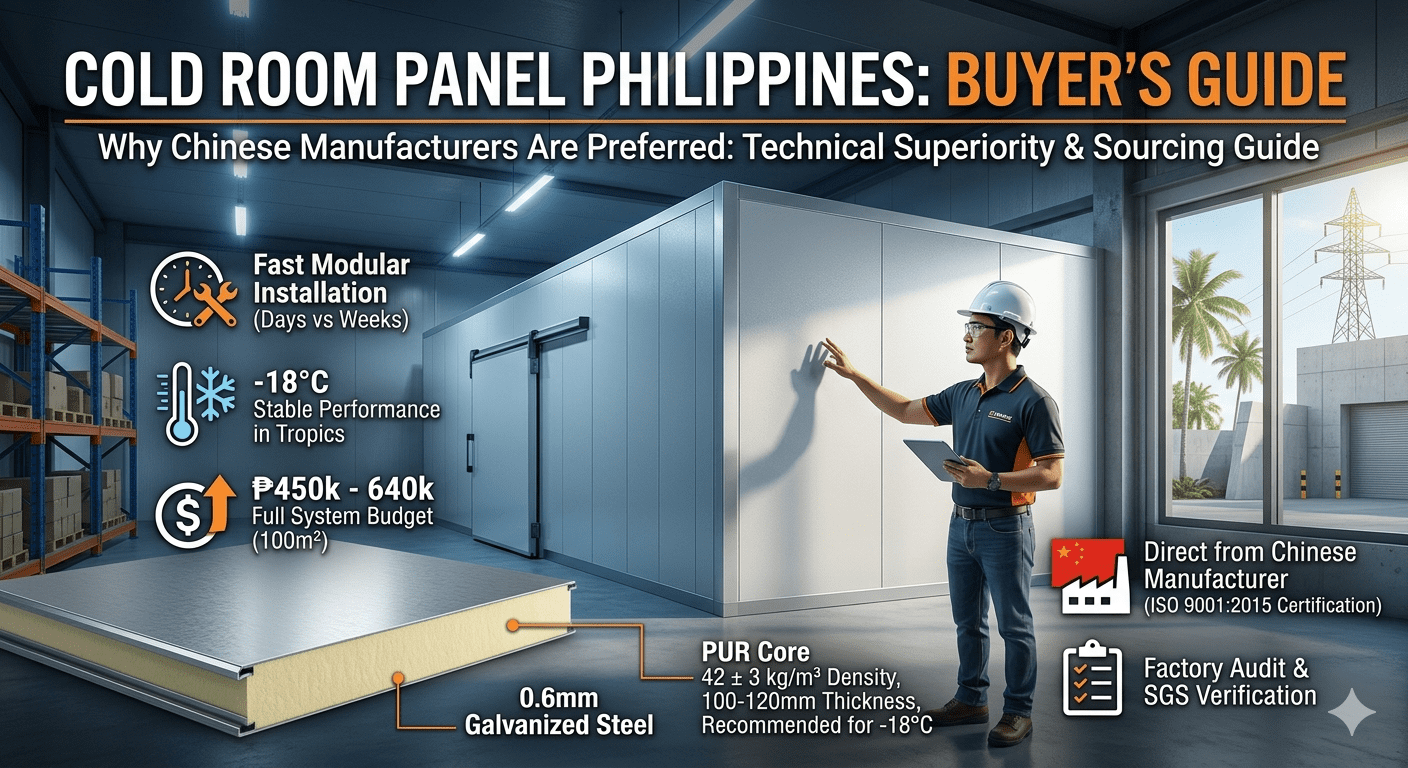
Polyurethane (PU) core is the market standard in the Philippines. Core density is tightly controlled at 42 ± 3 kg/m³. A 100mm PU panel delivers roughly R-5.5 to R-6.0 (metric: 0.88–0.96 m²K/W). When exterior ambient temperatures hit 38–40°C and you’re maintaining -18°C inside, 100mm is your practical minimum. Thinner panels save money upfront and cost you in compressor runtime every month after that.
Galvanized steel skins are standard and handle Philippine humidity well. Stainless steel (304 or 316 grade) costs 2.5–3× more—justified only for acidic product storage or coastal salt-air environments. Aluminum skins are lighter and corrosion-free, but they conduct cold faster than steel, causing thermal bridging at joints. The result: frost buildup at seams and efficiency losses. Skip aluminum for any -18°C application.
The practical recommendation: galvanized steel skins with a 100–120mm PU core. That combination balances performance, cost, and durability for most cold storage applications across the Philippines.
Cold Room Panel Philippines: Cost and ROI Breakdown
Installed panel costs typically run ₱1,800–₱2,400 per square meter, depending on thickness and finish. For a 100m² cold room at -18°C, panels alone run ₱180,000–₱240,000. Here’s how a full system budget looks:
- Panels: ₱180,000–₱240,000
- Flooring system: ₱80,000–₱120,000
- Refrigeration unit (5–7.5 HP): ₱150,000–₱220,000
- Installation labor: ₱40,000–₱60,000
- Total: approximately ₱450,000–₱640,000
Monthly electricity for a 5 HP unit running 16 hours daily in a properly insulated 100m² room runs ₱8,000–₱12,000 at ₱12–₱14 per kWh. Thin or poor-quality panels push that to ₱15,000 or higher.
Consider a fish processing facility in Navotas upgrading from an older room with 80mm panels. Switching to 120mm PU panels cut their monthly electricity bill by ₱3,200. Over four years, that’s ₱153,600 recovered—on top of reduced compressor wear from shorter runtime cycles. The panel upgrade paid for itself before the refrigeration unit needed its first major service.
That 30–40% energy reduction is realistic for most upgrades from thin or degraded insulation. Payback on the full system lands between 3–4 years when you factor in both energy savings and deferred equipment maintenance.
Installation Speed: Modular Panels vs. Conventional Construction
Conventional concrete block construction takes 6–8 weeks: foundation, masonry, insulation spray, finishing, then refrigeration. Modular cold room panels compress that dramatically:
- Days 1–2: Foundation prep and floor installation
- Days 3–5: Wall and ceiling panels assembled and sealed
- Days 6–7: Refrigeration unit installed and commissioned
- Day 8: Temperature validation and handover
Mechanically produced panels have an effective width of 1,120mm—fewer joints to seal, faster assembly. Hand-assembled alternatives run narrower at 960mm effective width, requiring more labor and more sealing points. For a business losing ₱50,000 daily in halted production, five weeks of saved construction time is worth more than ₱250,000 in recovered revenue alone.
Why Chinese Manufacturers Are the Preferred Choice for Philippine Buyers
For cold room panel procurement in the Philippines, an increasing number of facility managers are choosing to work directly with Chinese manufacturers rather than local or regional resellers. The reasoning is straightforward: China’s advanced manufacturing infrastructure, rigorous quality standards, and competitive pricing produce panels that outperform domestically-assembled or imported alternatives in both thermal efficiency and long-term reliability.
Technical Superiority and Production Maturity
China’s cold room panel industry has evolved over three decades of exporting to demanding markets across Southeast Asia, the Middle East, and Europe. Manufacturing facilities operate at ISO 9001:2015 certification levels, with automated production lines that hold panel dimensions to ±2mm tolerances — a level of precision that ensures airtight joints and eliminates thermal bridging. Core‑material formulations are optimized for tropical‑humidity conditions, achieving vapor permeability values below 0.5 µg/m·s·Pa, which prevents moisture absorption and delamination in high‑humidity environments like Metro Manila and coastal regions.
In comparison, many local Philippine assemblers rely on imported raw materials, hand‑assembly methods, and batch‑to‑batch variability that can compromise panel performance. Chinese factories produce panels at scale with quality‑control protocols (SGS third‑party verification, CE marking) that meet international building‑material standards — certifications that are often absent from locally assembled offerings.
Supply‑Chain Reliability and Lead‑Time Advantage
A Chinese manufacturer’s integrated supply chain — from steel‑coil procurement through to finished‑panel packaging — removes multiple intermediaries and shortens lead times to 15–20 working days for standard specifications. For Philippine buyers, that means faster project turnaround without compromising specification choices.
By contrast, Philippine‑based resellers often face extended lead times (4–6 weeks) as they consolidate orders, coordinate multiple suppliers, and manage import logistics. Direct sourcing from China streamlines that process and often reduces landed cost by 15–25%, even after factoring in sea‑freight expenses.
Practical Guidelines for Engaging a Chinese Supplier
When evaluating a Chinese manufacturer for cold room panels destined for the Philippines, focus on the following points to ensure a smooth project:
- Request factory audit documentation: Legitimate manufacturers will provide ISO 9001:2015 certification, SGS or equivalent third‑party test reports for thermal conductivity (λ‑value) and fire performance, and documented manufacturing process controls.
- Confirm shipping and customs experience: Ask for three recent shipment records to the Philippines, including destination port (Manila, Cebu, Davao) and typical door‑to‑door transit times. Experienced suppliers handle Bill of Lading, customs clearance, and local delivery coordination.
- Review panel‑joining system details: High‑quality Chinese panels feature factory‑applied polyurethane edge seals on all four sides — not just site‑applied silicone — which eliminates joint leakage and thermal bridging. Verify that the joining system matches Philippine humidity and seismic loading requirements.
- Demand a project‑specific technical data sheet: The supplier should provide a panel specification document listing core material (PUR density, λ‑value), skin material (galvanized steel thickness, coating type), effective width (standard 1,000mm), and fire‑rating classification per EN 13501‑1 or GB 8624.
- Arrange a video walk‑through of the production line: During the evaluation phase, schedule a 30‑minute live video tour of the factory floor — this demonstrates transparency and confirms automated production equipment, quality‑control checkpoints, and finished‑panel handling procedures.
For Philippine buyers accustomed to dealing with local resellers, the shift to direct manufacturer sourcing can appear daunting. In practice, the process is straightforward: clear technical specifications, documented quality certifications, and an established shipping protocol to the Philippines translate into higher‑performing panels, shorter lead times, and lower total project cost.
Making the Right Call on Cold Room Panels in the Philippines
The standard for -18°C cold storage in the Philippines is a 100–120mm polyurethane panel with galvanized steel skins, installed modularly. It delivers the right thermal performance for tropical conditions, installs in days rather than weeks, and pays back through energy savings within 3–4 years.
Choosing a cold room panel Philippines supplier means verifying local installation capacity, demanding documented specifications, and checking references before signing anything. A quality system runs reliably for 10–15 years. The upfront investment is real—so is the return.
Philippine‑specific note: In Metro Manila and other urban areas, electrical reliability can be a factor in cold‑room operation. Consider specifying panels with higher‑density PUR cores (42 ± 3 kg/m³) that maintain temperature for longer during brief power interruptions — a practical consideration for many Philippine food‑storage facilities.
Frequently Asked Questions
Is it worth saving money with 80mm panels?
You save ₱30,000–₱40,000 upfront and spend it back in compressor electricity within 18–24 months. For a -18°C application in the Philippines, 80mm is undersized. The math doesn’t work in your favor.
How long do cold room panels last?
10–15 years with regular maintenance. Panels themselves rarely fail—seals and gaskets at joints are where problems start. Inspect gaskets every six months and replace them when they show cracking or compression loss. That habit alone extends system life significantly.
Do I need stainless steel skins for a food storage application?
Not necessarily. Galvanized steel handles most food storage environments without issue. Stainless steel makes sense if you’re storing acidic products like citrus or vinegar-based goods, or if the facility is near the coast and exposed to salt air. Otherwise, galvanized steel with proper maintenance is the cost-effective choice.