
Southeast Asia Tropical Construction System: Complete Integration Guide 2026

Last Updated: April 2026 | Standards referenced: SNI 03-8421:2017 (mandatory Dec 2024), RA 9514 (Fire Code), TISI (Voluntary)
What is a Tropical Climate Construction System Integration Framework? A climate-adaptation framework that integrates four technical subsystems—climate intelligence, material specification, compliance mapping, and cost optimization—into a unified decision support tool for Southeast Asia’s diverse tropical conditions. This framework is designed for international suppliers seeking to enter Indonesia, Thailand, and Philippines markets, providing a methodology to validate temperate-climate solutions against equatorial performance requirements.
SNI Standards Update (December 2024): SNI 03-8421:2017, mandatory since December 2024, sets technical requirements for mineral wool insulation materials including rock wool sandwich panels. All suppliers entering Indonesia must obtain SNI marking and SPPT certificate through the LSPro (Product Certification Body) system. This framework shows how China-based manufacturers can map their GB/T standards to SNI 03-8421:2017 compliance pathways.
Disclosure: This framework is based on technical equivalency analysis between tropical climate zones and does not represent on-ground project experience in Southeast Asia. The methodology uses published climate data, regulatory documents, and material property databases to establish theoretical adaptation pathways. We are actively seeking pilot project partnerships to validate this framework under actual monsoon conditions.
Quick Answer
A tropical climate construction system integration framework provides international suppliers with a structured methodology to adapt temperate-climate solutions to Southeast Asia’s equatorial conditions through climate-data-driven specification, regulatory compliance mapping, and pilot validation pathways. For Indonesia specifically, this means validating sandwich panel systems against SNI 03-8421:2017 (mandatory since Dec 2024), calculating performance under monsoon wind loads per SNI 03-1727-2020, and establishing thermal equivalency between known climate zones (e.g., Hainan = Indonesia Java coast). The framework helps answer the critical question: “How can we confidently specify materials without local project experience?”
System Overview: The 4-Subsystem Integration Model
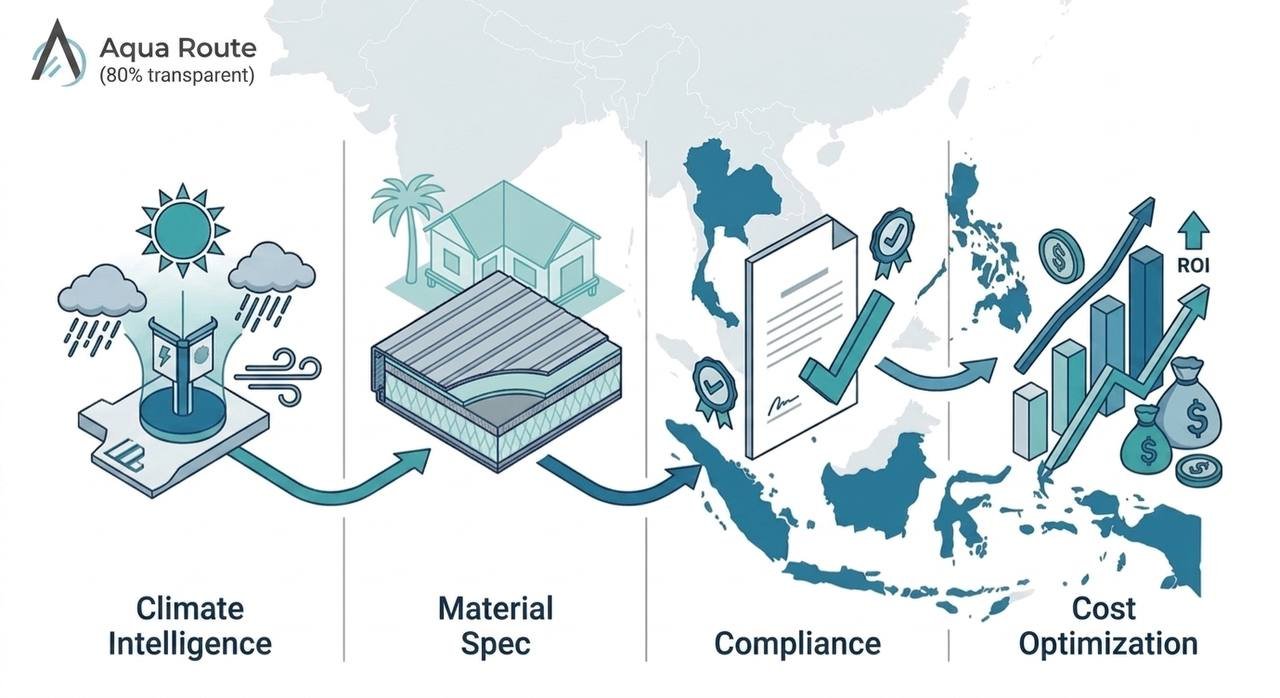
This framework integrates four interdependent technical subsystems to provide a structured adaptation pathway for industrial building solutions moving from temperate to tropical climates:
- Climate Intelligence Subsystem: Maps Southeast Asia climate zones to material performance requirements
- Material Specification Subsystem: Translates climate data into technical parameters for sandwich panels, doors, and loading equipment
- Compliance Integration Subsystem: Establishes equivalence pathways between international and local standards (e.g., China GB → Indonesia SNI)
- Cost Optimization Subsystem: Calculates lifecycle total cost of ownership (TCO) for different adaptation strategies
Link to Indonesia Implementation: For a specific application of this framework to Indonesia’s Karawang industrial zone with PU edge-seal technology, see our technical analysis: Indonesia climate adaptation case study.
Module 1: Climate Intelligence System
Climate data mapping for Southeast Asia
| Climate Zone | Average RH | Annual Rainfall | Equivalent Validation Zone |
|---|---|---|---|
| Indonesia (Java Coast) | 85-90% | 1,800-2,100mm | Hainan, China |
| Philippines (Metro Manila) | 70-85% | 2,000-2,200mm | Guangdong Coastal |
| Thailand (Bangkok) | 75-80% | 1,400-1,600mm | Guangxi |
Climate equivalency validation methodology:
- Match temperature/humidity profiles between Southeast Asia locations and Chinese coastal zones
- Validate material performance data from Chinese applications
- Apply tropical-specific degradation factors (salt spray, monsoon winds)
- Generate Southeast Asia-specific performance projections
Module 2: Material Specification System
From climate data to material parameters
The framework translates climate intelligence into specific technical requirements:
For Indonesia (85-90% RH, monsoon wind zone):
- Sandwich panel core: PU or rock wool with edge sealing
- Thickness selection: Based on thermal requirement (U-value target ≤0.25 W/m²K) and structural span
- 50-75mm: Light cladding, short spans
- 100-150mm: Standard industrial applications (most common)
- 200mm+: Cold storage or high thermal resistance requirements
- U-value: ≤0.25 W/m²K
- Water absorption: ≤2.5% (24h immersion)
- Wind load resistance: 2.5 kPa (monsoon-rated)
For Philippines (70-85% RH, typhoon zone):
- Sandwich panel core: PU with enhanced corrosion protection
- Thickness selection: Based on thermal requirement (U-value target ≤0.25 W/m²K) and structural span
- 50-75mm: Light cladding, short spans
- 100-150mm: Standard industrial applications (most common)
- 200mm+: Cold storage or high thermal resistance requirements
- U-value: ≤0.25 W/m²K
- Salt spray resistance: ≥1000h (Cebu coastal standard)
- Wind load resistance: 2.4 kPa (250 km/h typhoon equivalent)
Link to technical details: For comprehensive specifications on PU edge-seal technology in Indonesia, see Indonesia climate adaptation case study.
Product page link: View PU edge-sealed rock wool sandwich panel specifications.
Module 3: Compliance Integration System
International to local standard mapping
| China Standard | Indonesia | Thailand | Philippines |
|---|---|---|---|
| GB/T 23932-2009 (PU panels) | SNI 03-8421:2017 | TISI Voluntary (No mandatory standard) | N/A |
| GB 8624-2012 (Fire rating) | N/A | N/A | RA 9514 (Fire Code) Note: RA 9514 is the Fire Code of the Philippines, not a material testing standard. Specific material testing follows NFPA or other referenced standards. |
Important Note: Thailand currently does not have a mandatory national standard specifically for metal-faced sandwich panels equivalent to GB/T 23932-2009 or SNI 03-8421:2017. TISI (Thai Industrial Standards Institute) offers voluntary certification schemes for building materials, and specific project compliance is typically assessed on a case-by-case basis through local building authorities.
SNI 03-8421:2017 compliance pathway (Indonesia-specific):
- Prepare technical documentation in Chinese and English
- Engage LSPro (Product Certification Body) through local Indonesian partner
- Submit product samples for testing at Indonesian laboratory
- Obtain SPPT certificate (Product Certification Approval)
- Apply SNI marking on products for customs clearance
Module 4: Cost Optimization System
Total cost of ownership (TCO) model
Cost components for Southeast Asia market entry:
- Product adaptation costs (15-25% premium for tropical specifications)
- Compliance certification costs: Indonesia SNI 03-8421:2017: Testing fees + LSPro administrative costs + local partner fees, Philippines RA 9514: Third-party testing + compliance documentation
- Local partnership setup (distributor margin: 20-30%)
- Installation training and support costs
Note: Actual costs depend on product complexity, number of SKUs, testing laboratory selection, and local partner arrangements. Contact us for project-specific estimates.
ROI calculation for tropical adaptation:
- Without adaptation: Product failure within 18-24 months (replacement cost 100%)
- With adaptation: Product lifespan 5-7 years (annualized cost 14-20%)
- ROI period: 2-3 years for upfront adaptation investment
System Implementation Roadmap
Phase-by-phase market entry strategy
Phase 1: Climate Assessment (Week 1-2)
- Collect climate data for target markets (Indonesia/Thailand/Philippines)
- Identify equivalent Chinese climate zones
- Validate material performance projections
Phase 2: Material Specification (Week 3-4)
- Develop Southeast Asia-specific technical parameters
- Create adaptation specifications for existing product lines
- Prepare technical documentation for compliance submission
Phase 3: Compliance Preparation (Week 5-8)
- Identify local certification bodies and testing laboratories
- Prepare samples and documentation
- Initiate certification process through local partners
Phase 4: Pilot Installation (Month 3-6)
- Identify pilot project partners
- Implement adapted solutions on controlled scale
- Collect performance data for framework validation
FAQ (5 Questions)
Q1: How to evaluate supplier claims without local case studies?
Use the climate equivalency methodology: match your target market’s climate profile to a validated Chinese location (e.g., Hainan = Indonesia Java), then request performance data from that equivalent zone.
Q2: What’s the real maintenance cost difference in high humidity?
Based on Chinese coastal data (Hainan = Indonesia Java), maintenance costs increase 40-60% in 85%+ RH environments without proper edge sealing and corrosion protection.
Q3: How to handle SNI/当地认证 as a foreign supplier?
Partner with an established Indonesian distributor who has LSPro relationships. Key process stages include: (1) Documentation preparation in Indonesian/English, (2) Sample testing at accredited laboratories, (3) Factory audit by LSPro, (4) SPPT certificate issuance. Total timeline and costs vary significantly based on product complexity and LSPro processing capacity. We recommend engaging a local compliance consultant for project-specific planning.
Q4: Timeline for first installation in new market?
6-9 months minimum: 2 months for technical adaptation, 3-4 months for certification, 1-2 months for pilot project execution.
Q5: When to choose PU edge-seal vs standard panels?
When RH > 80% and annual rainfall > 1,500mm (Indonesia Java, Philippines wet season). Below these thresholds, standard sealing may be sufficient.
Next Steps
Ready to validate your project? Contact us for pilot partnership opportunities to test this framework under actual monsoon conditions.
For Indonesia-specific implementation details, return to our pillar page: Indonesia climate adaptation case study.
Part of our Tropical Construction Series
This article is part of our comprehensive guide to tropical climate construction in Southeast Asia:
- Indonesia Climate Adaptation System – Pillar page covering PU edge-seal technology for Indonesia’s humid climate
- Southeast Asia System Integration Framework – This article: System integration methodology for multiple markets
- High Humidity Material Performance Module – Upcoming: Detailed analysis of material behavior in 85%+ RH environments
- International Compliance Integration Module – Upcoming: Standard mapping and certification pathways
Professional Engineering Consulting Service
Expert technical support for high-performance building envelope systems.